LYOPRESTER® / DUAL-CHAMBER TECHNICAL GUIDE
Dual chamber is a category. Lyoprester® is a specific Panacea platform.
The words “dual chamber” only identify a two-compartment format. The solution represented by SUBVERIX™ is Panacea Bio Chem's Lyoprester® platform, described with argon, vacuum sealing, matched P‑EARL™ and EZnject™ activation.
The terms “dual-chamber cartridge” and “double-chamber cartridge” describe the same general principle: two components remain separated until a planned mixing step. This is not one universal construction. Systems may differ in geometry, materials, closures and activation mechanics.
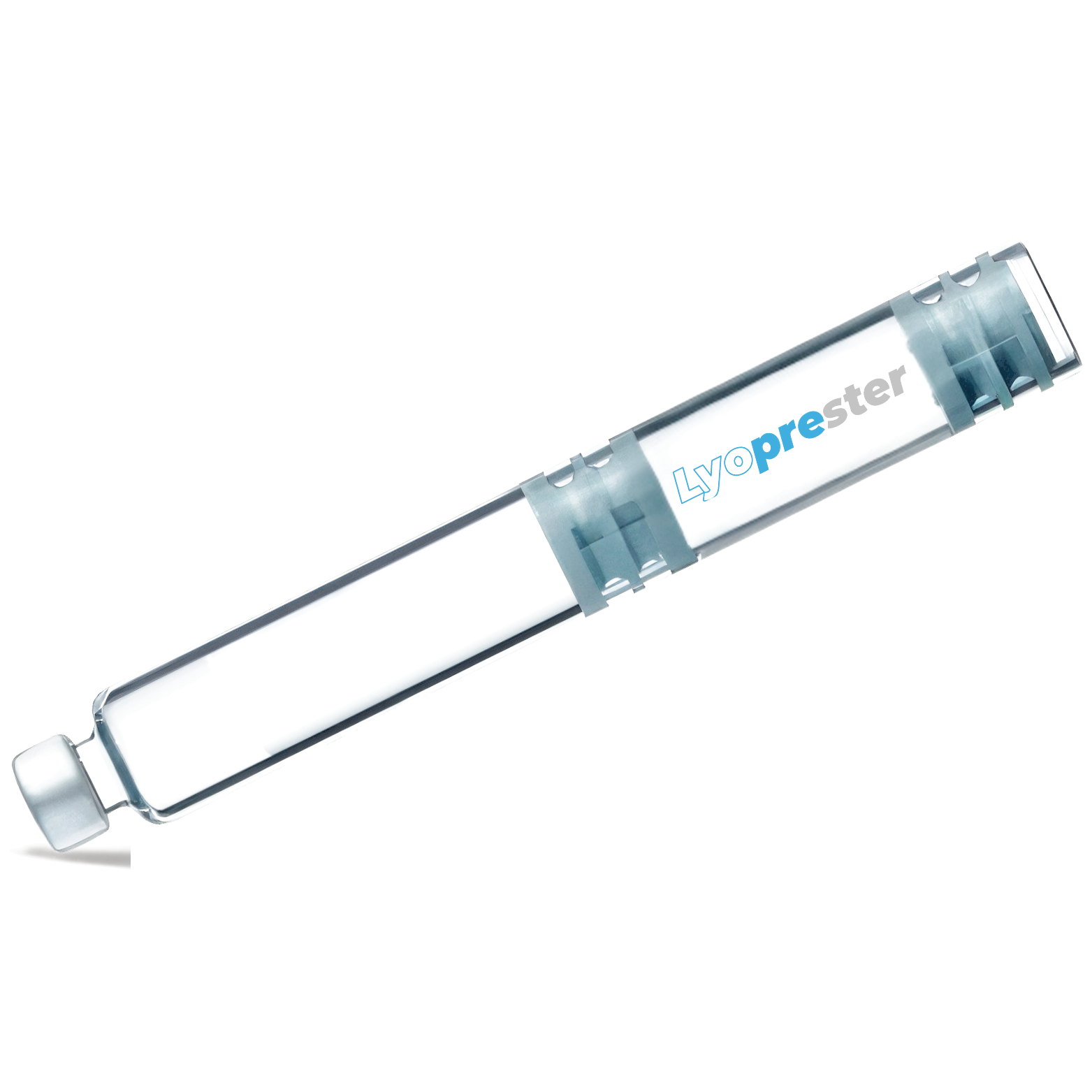 01 / DRY CHAMBER02 / PLUNGER + BYPASS03 / LIQUID CHAMBER
The lyophilised material and diluent remain in two separate chambers.
The middle plunger reaches the bypass and opens a controlled flow path.
Liquid enters the dry chamber without manual transfer between separate containers.
Not every dual chamber is a Lyoprester® system.
SUBVERIX™ represents a specific Panacea Bio Chem solution in its range. The difference is not merely two chambers; it is the combination of the cartridge, protective atmosphere, matched liquid and activation method as one platform.
Generic dual chamber
- Two chambers and a bypassDry material and liquid can remain separated until activation.
- Many configurationsAtmosphere, closure, liquid and delivery device depend on the specific manufacturer.
- A cartridge alone is not enoughThe format name does not say how the material was lyophilised or protected during storage.
- Stability needs evidenceTwo chambers do not automatically establish a storage period or temperature.
Lyoprester® by Panacea Bio Chem
- ArgonLock™ + vacuumPanacea describes an argon-flushed, vacuum-sealed lyophilised-material chamber.
- Matched P‑EARL™The formulation-matched reconstitution liquid is already held in the second chamber.
- EZnject™One activation combines both chambers through a closed path without a separate vial or manual transfer.
- A platform, not an empty cartridgeLyoprester®, P‑EARL™, EZnject™ and cartridge preparation are presented as one system.
One container, two separate environments.
Pharmaceutical-packaging manufacturers describe a dual-chamber cartridge as a container with two consecutive chambers separated by a movable middle plunger. In one common configuration, the front chamber contains lyophilised material and the rear chamber contains a liquid diluent.
Separation can be useful when storing both components together as a solution would be less favourable than storing them apart. The format alone does not establish a stability period; that requires data for the specific formulation, package and conditions.
SHORT DEFINITIONA dual-chamber cartridge stores two components separately and enables them to be combined inside one system at a planned moment.
The key elements are the chambers, plungers, closure and bypass.
- Front chamber
In a lyophilisate–diluent configuration, this chamber contains the dry, freeze-dried material.
- Middle plunger
It seals the boundary between the components during storage and transport.
- Rear chamber
It stores the liquid intended to reconstitute the material in the first chamber.
- Bypass
A shaped channel in the barrel wall creates a flow path around the middle plunger once it reaches the designed position.
- End plunger and closure
They support controlled movement of the contents and maintain container integrity.
The bypass opens a path only when the middle plunger reaches the correct position.
Before activation, the middle plunger separates the chambers. As the mechanism moves the plungers through the barrel, the middle plunger reaches the bypass section. The liquid can then move around the seal and enter the chamber containing the dry material.
The components are combined inside the container. This distinguishes the format from a conventional set consisting of a lyophilisate vial, a separate diluent container and transfer equipment. The exact movement sequence depends on the device used with the cartridge.
Fewer separate components do not mean fewer quality requirements.
SCHOTT Pharma notes that conventional lyophilisate reconstitution may involve a vial containing dry material, a diluent vial and a syringe. A dual-chamber cartridge integrates these functions in one container. Stevanato Group also describes fewer preparation steps than traditional vial-and-syringe combinations.
Integration does not automatically demonstrate sterility, material compatibility, accuracy or stability. These depend on the design, filling and lyophilisation process, closure integrity and validation of the complete system.
Compare the complete system, not the words “dual chamber”.
- What is stored in each chamber?
The format name does not replace specifications for the material and diluent.
- How was the cartridge made and closed?
Product-contact materials, bypass geometry and plungers are part of the quality system.
- Do the data concern the finished configuration?
A raw-material result does not automatically describe the product after filling, lyophilisation and closure.
- Which stability conditions were established?
Periods before and after reconstitution should apply to the specific formulation and package.
How to compare dual-chamber cartridge manufacturers and producers.
Searches for a dual-chamber cartridge manufacturer, producer or supplier can lead to companies with very different responsibilities. One may form the glass barrel and bypass, another may supply plungers and closures, another may make the delivery device, while a separate organisation performs filling, in-cartridge lyophilisation and final assembly.
A useful comparison therefore starts with a responsibility map. Documentation for an empty cartridge does not establish the quality of the filled material, and device documentation does not establish formulation stability. The strongest evidence connects the components, process and identified batch of the finished configuration.
- Manufacturing scope
Identify who is responsible for the cartridge barrel, elastomeric components, delivery device, filling, lyophilisation and final assembly.
- Specification and compatibility
Look for product-contact materials, dimensional tolerances, bypass geometry and evidence that the cartridge and device work together.
- Finished-system integrity
Check whether closure, transport and reconstitution evidence concerns the complete configuration rather than one isolated component.
- Traceable evidence
Documents should identify the tested sample, method, date, conditions and batch covered by the result.
We represent the Lyoprester® solution, not a generic dual-chamber cartridge.
SUBVERIX™ presents the Panacea Bio Chem platform in its range: Lyoprester® with matched P‑EARL™ liquid and the EZnject™ activation system. It is a named product architecture, not an interchangeable term for every dual-chamber cartridge.
The distinction is the integration of dry-material protection, reconstitution liquid and closed activation. Storage and stability conditions still require documentation for the specific formulation and batch.
- ArgonLock™ and vacuum sealing
Panacea describes protection of the material chamber with argon and a vacuum seal rather than uncontrolled air exposure.
- P‑EARL™ already integrated
Matched reconstitution liquid remains in the second chamber of the same cartridge until activation.
- Lyoprester® + EZnject™
The cartridge and activation mechanism form one closed path for combining the components.
Frequently asked questions.
01What is a dual-chamber cartridge?+
It is one cylindrical container with two consecutive chambers separated by a movable middle plunger. In a lyophilisate–diluent configuration, the dry material and liquid remain apart until the designed activation step.
02What does the bypass do in a dual-chamber cartridge?+
The bypass is a shaped channel in the cartridge wall. When the middle plunger reaches it, liquid can move around the seal and enter the chamber containing the dry material.
03Is a dual-chamber pen the same as a ready-mixed liquid pen?+
No. In a dual-chamber format, the dry material and diluent can remain separated until activation. A ready-mixed pen stores the material in solution from the beginning.
04Does a dual-chamber format prove a specific stability period?+
No. Cartridge design alone does not establish shelf life. Stability must be supported for the specific formulation, filling and lyophilisation process, closure system, package and storage conditions.
05What distinguishes the SUBVERIX dual-chamber format?+
SUBVERIX represents the Panacea Bio Chem Lyoprester® platform in its range rather than an anonymous dual-chamber cartridge. Panacea describes it with in-cartridge lyophilisation, an argon-flushed and vacuum-sealed material chamber, matched P‑EARL™ liquid and closed EZnject™ activation. Product-specific parameters still require documentation for the exact formulation and batch.
06How should dual-chamber cartridge manufacturers be compared?+
First identify who makes each component and who performs filling, lyophilisation and final assembly. Then compare product-contact materials, dimensional specifications, device compatibility, container-closure integrity, reconstitution performance and traceable evidence for the finished batch.
Evidence is most useful when its limits remain visible.
SUBVERIX™ separates scientific findings, technical declarations and verified product documentation so that each conclusion can be read in the correct context.
RETURN TO SCIENCE NEWSMaterials reviewed by the editorial team
Sources support the scientific and technical context of this article. They do not confirm the parameters of SUBVERIX™ products.
- 01Panacea Bio Chem / Lyoprester®OPEN SOURCE
Lyoprester® — intelligent reconstitution technology in dual-chamber cartridges
- 02Panacea Bio Chem / LyojectOPEN SOURCE
Lyophilised injectable delivery — Lyoprester®, P‑EARLs™ and EZnject™
- 03Panacea Bio ChemOPEN SOURCE
Panacea technologies — ArgonLock™, Cryolapse™ and Lyoprester®
- 04SCHOTT PharmaOPEN SOURCE
Cartridges Double Chamber (DC)
- 05Stevanato GroupOPEN SOURCE
Dual Chamber Cartridges for Lyophilized and Sensitive Drugs
- 06West Pharmaceutical ServicesOPEN SOURCE
FluroTec cartridge plungers — container closure integrity and material interaction